
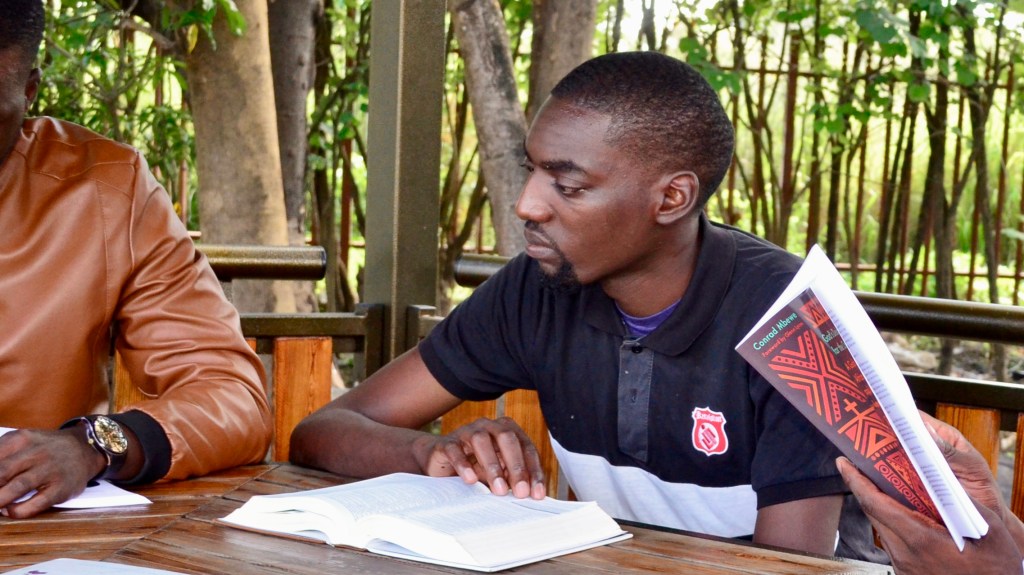
Series: The Great Need of Man, The Great Purpose of God Part 1.
Most of us grew up hearing that the world’s problems could be solved if we just fixed the right things – better leaders, better schools, better jobs. We see the headlines, scroll through the news, and feel the weight of political chaos, economic pressure, and personal pain. It’s easy to assume that if we could tweak a system, pass a law, or get a degree, things would finally change. But what if the Bible says our greatest need is deeper—and far more glorious—than any of those solutions can reach?
On December 17, 2010, a 26‑year‑old fruit and vegetable seller named Mohamed Bouazizi stood on the streets of Sidi Bouzid, Tunisia. He earned the equivalent of about $140 a month selling produce from a cart. That day, local officials confiscated his goods. Humiliated and refused a hearing at the municipal office, he walked across the street, bought a can of petrol, poured it over himself, and set himself on fire.
He died on January 4, 2011. Many say his act sparked what we now call the Arab Spring. Protests and revolutions spread across the Arab world. Governments fell. Long‑standing regimes toppled. The region was shaken.
Stories like this confront us with a sobering question: What is the great need of the world today? What kind of desperation drives someone to light himself on fire in public? Why are societies so brittle, so ready to break?
What Politicians Say We Need
If we were to ask the politicians, they would likely say that the great need of our world is better government. The problem, they would argue, is corrupt leadership, bad policies, oppressive systems. Just give people a better political structure, and things will improve.
US President Franklin D. Roosevelt, in his second inaugural address, said: “I see one-third of a nation ill-housed, ill-clad, ill-nourished. But it is not in despair that I paint you that picture. I paint it for you in hope—because the nation, seeing and understanding the injustice in it, proposes to paint it out.”
We can see repeated attempts in recent history to “fix” the world through political reform and democratization. Yet our world remains full of conflict, injustice, and disappointment. Better systems alone can’t heal the human heart.
“Gradually it was disclosed to me that the line separating good and evil passes not through states, nor between classes, nor between political parties either — but right through every human heart — and through all human hearts.” ― Goodreads. ―Aleksandr I. Solzhenitsyn, The Gulag Archipelago 1918–1956
What Educators Say We Need
Others would insist that education is our greatest need. “Ignorance,” they say, “is the biggest problem.
Listen to the opinions of two well-respected African leaders.
Nelson Mandela is credited as saying, “Education is the most powerful weapon which you can use to change the world.” ― Nelson Mandela, Madison Park High School, Boston, 23 June 1990
Kofi Anan said, “Knowledge is power. Information is liberating. Education is the premise of progress, in every society, in every family.” ― Global Partnership for Education UN Press Release SG/SM/6268, 23 June 1997
Over the past decades, organizations have poured enormous resources into spreading information—about health, economics, technology, and more. Much of this is genuinely important; we should be grateful for it.
But if education were enough, surely our world would look very different by now. We are more informed than any generation before us, yet still deeply broken. Knowledge alone cannot erase selfishness, pride, or sin.
What Humanitarians Say We Need
Still others argue that poverty is the core problem. That if we could eradicate poverty, we would solve most of the world’s pain. Consider again what Nelson Mandela said in a speech in Trafalgar Square, London, on February 3, 2005,
“Like slavery and apartheid, poverty is not natural. It is man-made and it can be overcome and eradicated by the actions of human beings. And overcoming poverty is not a gesture of charity. It is an act of justice. It is the protection of a fundamental human right, the right to dignity and a decent life. While poverty persists, there is no true freedom.”
I live a short distance from a community where many survive on the equivalent of a few dollars a day. The effects of poverty are heartbreaking: preventable diseases, children dying from illnesses easily treated elsewhere, families going to bed hungry, and hospitals without medicine at crucial moments. Poverty is real, cruel, and not to be minimized.
Yet even in places of relative wealth, we find addiction, abuse, despair, and spiritual emptiness. Material lack is not the only kind of poverty.
So again I ask you: What is the great need of the world?
The Church Is About God’s Purpose
To answer that question, we need to step back and see what God says He is doing in the world. The apostle Paul helps us in Ephesians chapter 1. There he lifts our eyes above politics, education, and economics, and reminds us what the church—and, by extension, the world—is ultimately about.
The church is about God and what He is doing in the universe.
That means something that may sound shocking at first: the church is not about you. The church does not exist primarily to make us feel comfortable, entertained, or affirmed. In many places, evangelical churches have slipped into a consumer mindset. We come for what we can get out of it. We treat church like a spiritual service provider.
We come to feed and then disappear. We arrive, take what we want, and leave again—often without any real investment in the people or the mission. That was never God’s intention for His church.
Far too often, we view church as something we attend rather than something we are. When the church is reduced to a consumer‑driven religious club, this living, breathing body—where Christ Himself dwells—ceases to fulfill the purpose for which it exists. It becomes just another social organization.
If the church of Jesus Christ is not fulfilling the mission of God, it has no reason to exist.
As we wrestle with stories of injustice, poverty, and despair, we must resist the temptation to answer too quickly. Before we settle on what the world most needs, we must listen carefully to what God says He is doing in the world. Only then will our concern for politics, education, and relief work be anchored in something that can actually last.


Leave a Reply