
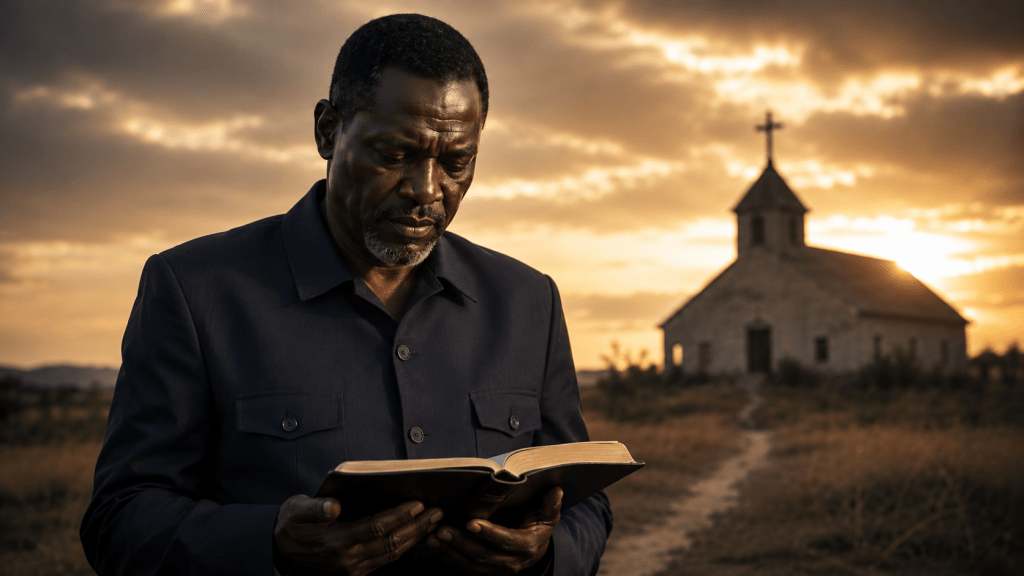
Every generation has a battle to fight and an enemy to face. The enemy of our souls does not sit idly by; he wages war against the souls of men.
We need men who are courageous, not cowards (2 Timothy 1:7; 1 Corinthians 16:13). We need men who are humble, not haughty (Philippians 2:5-8). We need men who are soldiers, not spectators (2 Timothy 2:3-4). We need men who have counted the cost (Luke 14:26–33), men who love God more than family, houses, or lands, and who will follow Christ whatever the cost.
We need New Testament prophets, men like Ezekiel, who are willing to bear the iniquity of the people they are called to serve. We need men who will stand faithfully on God’s Word, proclaim His truth without compromise, and endure hardship for the sake of Christ and His church.
In chapter 1, Ezekiel was called to be God’s man, commissioned to deliver God’s message to God’s people. From the very beginning, the Lord warned him that he would proclaim the truth to a people whose hearts were hard and whose foreheads were like flint (Ezekiel 3:8–9; Isaiah 6:9–10). Simply put, God was telling Ezekiel that he would labor faithfully in ministry, yet the people to whom he was sent would refuse to listen.
Then, in chapter 4, God instructed Ezekiel to draw an image of the city of Jerusalem and build siege works around it. After this, he was commanded to lie on his left side for 390 days and then on his right side for 40 days, for a total of 430 days. During this time, God said, “I have laid on you the iniquity of the house of Israel,” and later, “You shall bear the iniquity of the house of Judah” (Isaiah 53:11). As a prophet, Ezekiel was called to enter into the suffering brought about by the rebellion of the very people he had been sent to warn.
This pattern extends beyond Ezekiel to every servant of God. We will not reach those who have never heard unless we recognize that our calling is not only to proclaim the truth but also to identify with the people to whom God has sent us (Philippians 2:5–8; Hebrews 4:15). While we can never bear their sin in the atoning sense, that work belongs to Christ alone, we are called to bear the cost of loving them, serving them, and suffering alongside them as they experience the painful consequences of sin and rebellion against God (Colossians 1:24).
But God’s man is called to more than identifying with the suffering of those to whom he is sent. There are also times when God calls His servant to remain faithful to the mission in the midst of profound personal suffering.
In Ezekiel 24:16–18, the Lord tells Ezekiel that his wife, whom He calls “the delight of your eyes,” will die suddenly. Yet Ezekiel is commanded to continue faithfully carrying out his prophetic ministry, setting aside the customary public mourning rituals. The account is among the most moving in all of Scripture:
“So I spoke to the people in the morning, and at evening my wife died. And on the next morning I did as I was commanded.”
Ezekiel’s personal loss became a sign to the nation of Israel. His obedience in the midst of unimaginable grief authenticated the message he proclaimed. God did not remove His servant from ministry because of his suffering; rather, He incorporated that suffering into the prophetic witness itself (2 Corinthians 4:10–12).
The same principle often remains true today. God may, in His sovereign wisdom, require His servants to endure deep personal suffering in order to demonstrate the reality of their faith before a watching world (1 Peter 4:12–13). Those who do not know Christ are often less persuaded by what we preach than by how we endure suffering. Faithfulness in affliction gives credibility to the gospel we proclaim (Acts 5:41; 2 Corinthians 1:5–7).
Too often, we want to preach to people without entering into their lives. We want to proclaim the message without embracing the hardship that accompanies faithful ministry (1 Thessalonians 2:8). Yet biblical ministry requires both proclamation and identification. It requires truth spoken with conviction and lives lived in sacrificial service.
Failure to identify with the people to whom God has sent us will often result in a failure to establish a genuine gospel foothold or to see healthy, reproducing churches planted. Gospel ministry requires more than preaching from a distance. It requires entering into the lives of the people, patiently enduring hardship with them, and faithfully remaining among them until Christ is formed in them (Galatians 4:19).
This is the kind of man the church needs today: a man who is courageous enough to speak the truth, humble enough to serve, steadfast enough to suffer, and faithful enough to remain. Such men are instruments in the hands of God for the advance of His kingdom and the establishment of healthy, reproducing churches among the nations.



Leave a Reply