
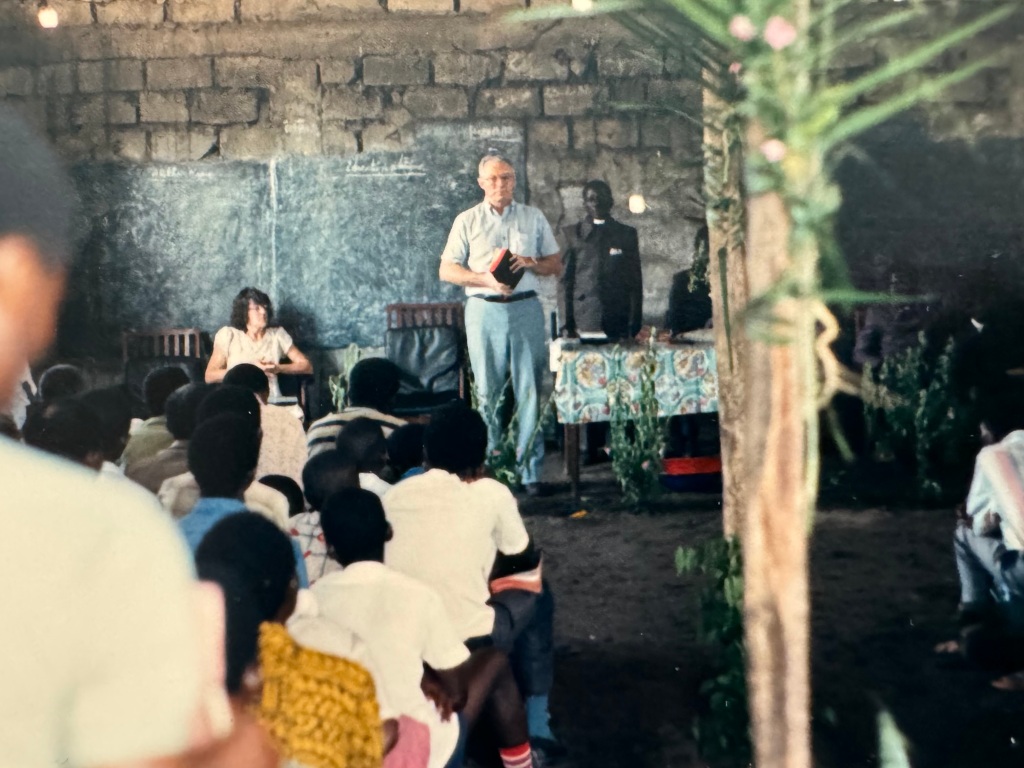
I first heard Darrell Champlin preach in 1987 at our a little home church in Atkinson, New Hampshire. He and his wife Louise were supported by Pentucket Baptist Church, where we were members, pastored at the time by Dan Sherman.
Darrell was the guest speaker our annual missions conference – I listened to his one-hour-fifteen minute expositional sermons filled with references to the glory, sovereignty and majesty of the “God of Heaven”, and illustrations of a God who works to save the lost in hard places, on the edge of my seat!

One of the sermons I heard Darrell preach was, The Principle of Capacity. I have taken great liberty to edit his sermon in this post, because the lesson contained here has been one that has been of great help to me through the years of service to Christ in Africa.
A Needed Ministry Principle
As missionaries and pastors, we often struggle with two areas related to capacity. The first is our hearers’ response to evangelism, and the second, perhaps more challenging, is their response to discipleship and the spiritual growth of new converts.
When it comes to evangelism we recognize the hardness of the human heart and the miraculous work of the Holy Spirit required for a lost sinner’s salvation. While we long for the salvation of the lost and invest much effort and prayer toward that end, we don’t necessarily expect all or even a majority to turn to Christ as Savior. We rejoice when some come to God, understanding the challenges inherent in evangelism, and the sovereignty of God in drawing men to repentance and faith.
Capacity in Discipleship
However, the matter of discipleship is a different story. Countless pastors and missionaries have become discouraged and disillusioned due to the perceived failure of converts to demonstrate growth and obedience to the Word of God. Much of this disillusionment could have been avoided if they had understood the principle of capacity.
The Parable of the Sower
In Matthew 13:23, Jesus describes what He calls “good ground” – hearts where the gospel takes root and bears fruit. Importantly, this fruit is not only for the salvation of the soul but also for the eventual growth that will result in the life of the believer. All the ground in verse 23 is described as “good ground” – ground that produces faith and fruit. But of this “good ground,” we can expect some to bear thirty-fold, some sixty-fold, and some a hundred-fold. What is being spoken of here is capacity. Some, when saved, have the capacity to produce thirty-fold fruit. Others are recognized as having the capacity for sixty-fold, and still others, a hundred-fold.
The Parable of the Talents
Similarly, in Matthew 25:14-30, we read of a master who gave his servants differing numbers of talents “according to his several ability.” Each servant received talents according to his capacity. One received five talents, another two, and the third, one talent. The servant with five talents was expected to make more of them than the other two, and the second servant more than the third. In every case, however, they received according to their capacity and would be rewarded according to the degree to which they lived up to that capacity. Those who lived up to their capacity were rewarded with the master’s “Well done, good and faithful servant.” The third servant would certainly have received the same praise if he had served according to his capacity. Alas, it was not to be.
The responsibility of the believer is not to change his capacity but to live up to it by the grace of God.
Darrell Champlin
Varying Capacities Among Believers
The purpose of these parables is to demonstrate that those who become children of God through the new birth have varying capacities by nature and character. Some are “thirty-fold” believers, responsible for one talent. Others are “sixty-fold” believers, responsible for two talents. Still, others are “hundred-fold” believers, responsible for five talents. Nowhere is there any indication that a “thirty-fold” believer will ever become a “sixty-fold” or “hundred-fold” believer. Nowhere are we taught that a “sixty-fold” believer can become a “hundred-fold” believer, receiving five talents instead of two. Nowhere is there any indication that the passage of time, the gaining of experience, or the process of teaching and training can change the basic capacity of the believer. The responsibility of the believer is not to change his capacity but to live up to it by the grace of God.
Application for Pastors and Missionaries
If this principle is understood, the pastor or missionary will not despair when some believers fail to grow past the thirty-fold or sixty-fold point. Instead, they will be faithful in taking those believers as far as their capacity will allow and will learn to rejoice in the fruit borne, though it may not be especially plentiful. You don’t criticize a short basketball player because he cannot “sweep the boards,” as those familiar with sports vernacular would understand.
In conclusion, the principle of capacity teaches us that believers have varying levels of spiritual capacity, and our role as leaders is to recognize and nurture that capacity, not to expect everyone to reach the same level of fruitfulness. By understanding this principle, we can avoid disillusionment and find joy in the growth of each believer, no matter their level of fruitfulness.
SOME ADDITIONAL POINTS FOR PERSONAL APPLICATION
For those following Christ:
1. Recognize individual capacities: Understand that each believer has a unique capacity for spiritual growth and fruitfulness. This can help us avoid unrealistic expectations of ourselves and others.
2. Focus on faithfulness, not comparison: Rather than comparing ourselves to others or trying to change our inherent capacity, we should strive to be faithful with what we’ve been given. (See more detailed application in the next section)
3. Celebrate diverse growth: Appreciate that spiritual growth and fruit-bearing look different for each person. Rejoice in the progress of others, whether it’s “thirty-fold,” “sixty-fold,” or “hundred-fold.”
4. Avoid discouragement in ministry: For those in leadership roles, understanding the principle of capacity can prevent disillusionment when not everyone grows at the same rate or to the same degree.
5. Nurture individual potential: As disciples or leaders, focus on helping each person reach their full potential within their capacity rather than trying to force everyone into the same mold. A faithful rural pastor should not compare themselves and their ministry to any famous, well-known pastor.
6. Trust in God’s sovereignty: Recognize that God gives different capacities and talents according to His wisdom, just as the master in the parable distributed talents “according to his several ability.” God is sovereign in the fruitfulness of each servant.
7. Seek personal growth: While we may not be able to change our fundamental capacity, we can still strive to bear fruit to the full extent of our ability, relying on God’s grace.
8. Practice patience and perseverance: Understanding capacity can help us be more patient with the spiritual growth process, both in ourselves and others.
For Those Tempted to Compare Themselves With Others:
The principle of capacity can be very liberating when it comes to freeing someone from comparing themselves to others. Here’s how it helps:
1. Unique design: Each one of us was created in the image of God, and the goal of this image bearing is to conform to the image of God’s Son, Jesus Christ. Understanding that each person has a God-given capacity helps us recognize that we’re not meant to be carbon copies of one another. Just as the servants in the parable received different numbers of talents, we each have our own unique spiritual “capacity.”
2. Shifting focus: Instead of looking at others and feeling inadequate, this principle encourages us to focus on our own growth and faithfulness within our capacity. The goal becomes living up to our own potential rather than matching someone else’s achievements. Our focus should be on our Master, the Lord Jesus Christ, if He is pleased then that is all we need!
3. Redefining success: Success is redefined as being faithful with what we’ve been given, rather than producing a specific amount of “fruit” or reaching a certain level of spiritual maturity compared to others.
4. Celebrating diverse giftings in the church: Recognizing different capacities allows us to appreciate the diverse ways God works through various individuals. We can celebrate others’ growth without feeling threatened or inferior, thus maintaining the unity of the Spirit in the bond of peace.
5. Removing unrealistic expectations: This principle helps remove the pressure to perform at the same level as those with different capacities. It’s freeing to realize we’re not expected to be a “hundred-fold” producer if we’ve been given a “thirty-fold” capacity.
6. Encouraging contentment: Understanding capacity can foster contentment with our own spiritual journey, reducing the tendency to covet others’ gifts or progress. One Christian vice is the sin of covetousness—in our Christian life or ministry, we can fall into the trap of coveting someone else’s ministry success. How many conflicts in the church can be traced to the sin of covetousness?
7. Promoting self-awareness: It encourages us to focus on understanding our strengths, weaknesses, and areas of potential growth rather than constantly looking to others as a benchmark for our fruitfulness.
8. Shifting accountability: Our accountability becomes about how well we steward what we’ve been given, not how we measure up to others. This aligns with the parable where each servant was judged based on what they did with their own talents, not in comparison to the others.
By internalizing this principle, followers of Christ can find freedom from the burden of comparison and instead focus on their personal relationship with God and their unique path of growth and service.
Edited by Claude.ai




 Zambia Hunt
Leave a reply to A La Carte (June 27) | BiblicalCounselor.com Cancel reply