
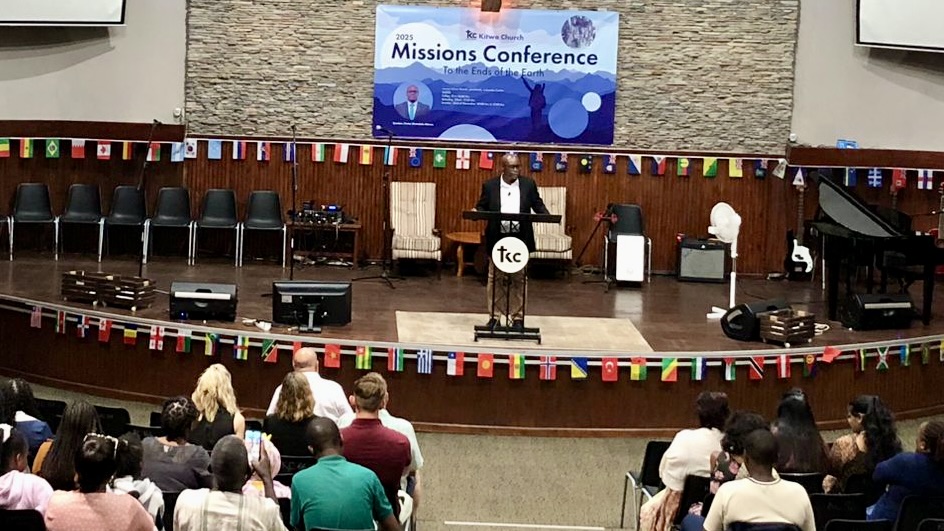
Pastor Mwindula Mbewe
Preached at Kitwe Church Missions Conference
https://www.sermonaudio.com/sermons/1123251635506474
23 November 2025
We come to the final chapter of the book of Jonah as we consider God’s desire to reach the ends of the earth with the gospel message of his Son and the salvation he has brought. This last chapter is meant to be the big reveal, the resolution that helps us understand what has really been happening throughout the book—particularly why Jonah was so opposed to going to Nineveh. Even though God broke him in chapter two, by chapter four we seem to be back to square one. Jonah is still clearly struggling with the idea that God would reach the city of Nineveh.
God’s mission is so radical it has a tendency to offend us. That’s what’s happening with Jonah. Let’s read about it from Jonah 3:10 through the end of chapter 4:
“When God saw what they did, how they turned from their evil way, God relented of the disaster that he had said he would do to them, and he did not do it. But it displeased Jonah exceedingly, and he was angry. And he prayed to the LORD and said, ‘O LORD, is not this what I said when I was yet in my country? That is why I made haste to flee to Tarshish, for I knew that you are a gracious God and merciful, slow to anger and abounding in steadfast love and relenting from disaster. Therefore now, O LORD, please take my life from me, for it is better for me to die than to live.’ And the LORD said, ‘Do you do well to be angry?’
Jonah went out of the city and sat to the east of the city and made a booth for himself there. He sat under it in the shade till he should see what would become of the city. Now the LORD God appointed a plant and made it come up over Jonah, that it might be a shade over his head, to save him from his discomfort. So Jonah was exceedingly glad because of the plant. But when dawn came up the next day, God appointed a worm that attacked the plant, so that it withered. When the sun rose, God appointed a scorching east wind, and the sun beat down on the head of Jonah so that he was faint. And he asked that he might die and said, ‘It is better for me to die than to live.’ But God said to Jonah, ‘Do you do well to be angry for the plant?’ And he said, ‘Yes, I do well to be angry, angry enough to die.’ And the LORD said, ‘You pity the plant, for which you did not labor, nor did you make it grow, which came into being in a night and perished in a night. And should not I pity Nineveh, that great city, in which there are more than 120,000 persons who do not know their right hand from their left, and also much cattle?’”
GOD’S MISSION REVEALS THE OFFENSIVE NATURE OF GOD’S LOVE
Up until this point, I’ve deliberately avoided explaining why Jonah was so opposed to going to Nineveh. Jonah preferred to leave the presence of God—and Israelites were all about the presence of God. That was everything to them: God with us. So why was Jonah so offended that God wanted to reach Nineveh that he chose to leave the presence of God for good and go die somewhere thousands of miles away?
The reason is given in chapter four. Jonah prays to the Lord: “O LORD, is not this what I said when I was yet in my country? That is why I made haste to flee to Tarshish, for I knew that you are a gracious God and merciful, slow to anger and abounding in steadfast love and relenting from disaster.”
Jonah did not want to go to Nineveh because he knew that God would have mercy on Nineveh through his preaching. He knew God too well. He knew that if he obeyed God and went to preach, God would extend his merciful and gracious hand to that city—and that’s exactly what he was trying to avoid. In other words, he wanted Nineveh to perish. He didn’t want them to be saved. He knew if he obeyed God, they would be saved.
Where was the problem?
Nineveh was the capital of the great empire of Assyria. We know about Egypt, which enslaved the Israelites for 400 years. We know about Babylon, which took the Israelites into exile out of the promised land. But between these two empires stood the Assyrians. The Assyrians were an empire like no other—bent on expansion and domination, which they achieved through brutality.
Just the name—”the Assyrians are coming”—was enough to strike fear into the heart of any nation. They were brutal and evil in the way they completely destroyed their enemies. They didn’t simply kill—they made examples of people, ensuring they died in the most brutal ways possible. This was deliberate, designed to drive fear into their enemies long before they even arrived.
The book of Nahum testifies to this. Nahum comes about 100 years after Jonah, and even though Nineveh repented and was spared, after a century they returned to their old ways. This is what God pronounces as judgment against them—this time with no forgiveness:
“Woe to the bloody city, all full of lies and plunder—no end to the prey! The crack of the whip, and rumble of the wheel, galloping horse and bounding chariot! Horsemen charging, flashing sword and glittering spear, hosts of slain, heaps of corpses, dead bodies without end—they stumble over the bodies!” (Nahum 3:1-3).
God calls Nineveh “the bloody city.” The Ninevites were brutal, barbaric people—vicious and violent. They didn’t just kill people; they lynched them. Historical accounts confirm they would cut off heads and pile them into heaps. Those heads would decompose until only skulls remained, heaped up as a testament to what would happen to anyone who stood in their way. One commentator notes that the Assyrians would cut open the bellies of pregnant women so their unborn children would spill out, and both child and mother would die.
These were the Taliban of their day. The Al-Qaeda. The Boko Haram. People guilty of atrocities that make your skin crawl.
Now imagine Jonah being told, “Go preach to them.” And imagine Jonah knowing, “If I go and preach to them, they will be saved.” Now you understand where Jonah was coming from. Now you understand why he preferred to die rather than fulfill this mission. He hated the Assyrians—and for good reason.
Furthermore, the Assyrians had a long history of warfare with the Israelites. Before Jonah came on the scene, kings of Israel paid tribute to the kings of Assyria.[1]
Jonah’s reaction is normal. Many of us would react the same way. This is like someone raping and killing your loved one, then being asked to go share the gospel with them. How many of us would be willing? This was a tough assignment for Jonah.
No wonder at the end of chapter three, when God sees how the Ninevites turned from their evil way and relents from destroying them, chapter four opens with: “But it displeased Jonah exceedingly, and he was angry.” He didn’t even wait for God to approach him—he went after God. He prayed: “O LORD, is not this what I said when I was yet in my country? That is why I made haste to flee to Tarshish, for I knew that you are a gracious God and merciful, slow to anger and abounding in steadfast love and relenting from disaster.”
God asks him in verse four: “Do you do well to be angry?”
What does Jonah do in verse five? He goes out of the city, sits to the east, and makes a booth for himself. For what purpose? “He sat under it in the shade till he should see what would become of the city.” He thinks his protest to God—imagine telling God, “You see? This is what I was trying to avoid”—combined with God’s seemingly passive response (“Do you do well to be angry?”) means God is convinced. He thinks God will actually change his mind and destroy the city. So he literally goes and sits on a mountain outside the city, makes himself a seat, crosses his legs, and waits for God to breathe down fire from heaven and annihilate this evil, wicked city.
Who can blame Jonah? Just as many people choose to attend the execution of a murderer who killed their loved one, there’s a sense of justice—a desire to see retribution. This is the plot of half the movies we love: some man minding his own business with his wife and children when enemies storm in and kill his family. The movie begins, and we know what’s going to happen. It fills us with satisfaction as we watch him hunt those enemies down one by one. That’s Jonah.
What Jonah never accounted for was the great love of God. It never crossed his mind that God’s great love might be directed toward the most detestable and abhorrent of people.
We all love God’s love when it’s directed to us. We love it—until we realize God’s love is also directed toward our enemies. Toward the evil boss who makes your life hell, to the point that you’d rather quit and go on the streets without pay just to escape. Then it hits you: “God loves my evil, wicked boss too?”
We love God’s love until we realize it’s directed toward the father who abandoned our mother, our siblings, and ourselves while we were still young—who ran off with someone else and loved his mistress and the children he had with her while we suffered. Then we realize: “God loves him too?”
This is especially difficult when God’s love is directed toward someone who abused you—even sexually abused or raped you.
Yes, God’s love is wonderful—until it’s directed to our enemies. That’s where Jonah finds himself. He cannot make sense of this. “God, how can you care for such terrible people?”
But that is the greatness of the love of God. When we sing, “How wide, how high, how deep is the love of God,” we’re not just talking about God’s love for us—”Lord, I’ve sinned so much yet you’ve loved me.” It’s also about our enemies. Those we despise and wish judgment would fall upon. God’s love is so high, so wide, so deep—even for them. And it’s offensive. It offends our sensibilities.
This isn’t just about salvation. Look at Matthew 5:43. This is about God’s general compassion, God’s general patience, that he causes the rain to fall on both the just and the unjust.
How can rapists, murderers, corrupt government officials, and thieves thrive and prosper under God’s watchful eye? “God, what are you doing?” Surprise—you may realize that God cares for those people too.
Matthew 5:43-48: “You have heard that it was said, ‘You shall love your neighbor and hate your enemy.’ That’s standard practice, the dogma and doctrine of the world: you slap me on one cheek, I’ll slap you back. But I say to you, love your enemies and pray for those who persecute you, so that you may be sons of your Father who is in heaven. For he makes his sun rise on the evil and on the good, and sends rain on the just and on the unjust. For if you love those who love you, what reward do you have? Do not even the tax collectors do the same? And if you greet only your brothers, what more are you doing than others? Do not even the Gentiles do the same? You therefore must be perfect, as your heavenly Father is perfect.”
That is why a Christian must never give in to hate and bitterness. You cannot be a good Christian and entertain those attitudes in your heart. The one for whom you bear hatred and bitterness may be loved by God.
What happens when your sworn enemy—that evil boss, that evil neighbor with whom you’ve even exchanged harsh words—comes to church on Sunday? Your church. And you know how God works. Where will the usher lead them to sit? Where will the only empty seat be? Right next to you. Always.
Now how are you going to sing “Amazing Grace”? “How sweet the sound that saved a wretch like me.” You see them every Sunday raising your hands and closing your eyes. Are you going to do it now? You exchanged insults with this person Saturday night. Now they’ve come to church. What happens?
There’s no place for hatred in the Christian faith when we understand the greatness of God’s love to reach people to the ends of the earth—which may include our enemies. So love your enemies. Forgive them.
Sometimes we think we should only forgive those who say sorry to us. Wrong. Forgiveness means you don’t treat people as their sins deserve. And you can do that for any enemy. That’s what God does. He doesn’t treat wicked, evil sinners as their sins deserve. He’s compassionate, patient, gracious. Don’t treat them as their sins deserve. God says, “Vengeance is mine, I will repay. Leave it to me. I’ll take care of it. You just love them. I’ll sort them out. You focus on the mission.” And know that God might just have his eyes set on someone you absolutely despise.
Missions would not be possible without this understanding of the love of God. People have gone into territories where they’ve been abused, mistreated, even killed, taking the gospel. And more people have been sent.
One of the greatest examples is Operation Auca. On January 8, 1956, five young American missionaries tried to make friendly contact with a tribe in Ecuador. This tribe had kept itself from integrating with society and remained primitive in their ways—wearing animal skins and maintaining a primitive way of life. They were known as violent, and “Auca” means “savage” in the local language.
These five men decided to take the gospel to this tribe. They flew a plane overhead and dropped gifts, saying, “When these gifts are accepted, we’ll land and introduce ourselves, show we’re friendly, and then give them the gospel.” They did that on January 8, 1956.
Two days later, when they actually landed and made contact with the tribe, all five men were killed on the beach. Their bodies were found mutilated in the river—speared, killed, and thrown in. These were young men: the oldest was 32, the others 28, 27, 27, and 22.
What happened next was truly extraordinary. The wife of one of the men—Jim Elliot’s wife, Elisabeth Elliot—decided two years later to move in with the tribe to evangelize them. That translates in any language. To see the people who killed your loved ones, and now their wives are coming saying, “We still love you and we have a message to share with you.” You don’t even need to know the language—that breaks hard hearts.
But what is that? That’s the great love of God. That’s the offensive love of God—that I would go and evangelize my husband’s killers who have left my child orphaned.
The older sister of one of the other men who was killed also went in to evangelize the tribe. These two women who had lost the men in their families moved in with the tribe and began evangelizing, and people got saved. Two of the men who were involved in killing those five missionaries became elders of the church and even baptized the son of one of the men they killed.
That’s the great love of God.
And that is what Jonah hates here—the love of God. “It displeased Jonah exceedingly, and he was angry.” There’s a big problem when you despise the love and grace of God.
GOD’S MISSION OFFENDS OUR IDOLS
Look again at Jonah. God uses a strategy to expose the idol in Jonah’s heart. Let’s try to understand it.
Jonah 4:5-9: “Jonah went out of the city and sat to the east of the city and made a booth for himself there. He sat under it in the shade till he should see what would become of the city. Now the LORD God appointed a plant and made it come up over Jonah, that it might be a shade over his head, to save him from his discomfort. So Jonah was exceedingly glad because of the plant. But when dawn came up the next day, God appointed a worm that attacked the plant, so that it withered. When the sun rose, God appointed a scorching east wind, and the sun beat down on the head of Jonah so that he was faint. And he asked that he might die and said, ‘It is better for me to die than to live.’ But God said to Jonah, ‘Do you do well to be angry for the plant?’ And he said, ‘Yes, I do well to be angry, angry enough to die.’”
And God makes his point in verses 10-11: “And the LORD said, ‘You pity the plant, for which you did not labor, nor did you make it grow, which came into being in a night and perished in a night. And should not I pity Nineveh, that great city, in which there are more than 120,000 persons who do not know their right hand from their left, and also much cattle?’”
What’s God doing? He’s exposing the idol in Jonah’s heart.
When you can’t get on board with what God is doing, then you have something or someone more important than God in your life. Let me say that again: When you cannot get on board with what God is doing, then there is something or someone in your heart that has taken God’s place.
For Jonah, it was his nation, Israel. Israel had become more important than God. Jonah’s ministry occurred during a time when Israel was enjoying the greatest growth and prosperity since the days of David and Solomon. They were on the rise, doing well. And the Assyrian empire was at its weakest. Jonah was hopeful that the Assyrian empire would be crushed so Israel could grow from strength to strength and become what God had always promised: a great nation with God as their God and they as his people, the dominant empire of the region. That was Jonah’s hope. And it was God’s promise. As far as he was concerned, it aligned with God’s will.
So when God said, “Go and preach to these people who are our enemies,” Jonah knew God was giving them a lifeline. “God, if I go preach, you’ll spare them and they will survive. They’re on their way down. Let’s just allow them to go down. You want me to give them a lifeline? Don’t you know they may rise again and attack us?”
And that’s exactly what happened. They survived and grew into an even greater empire. They captured 46 cities of Judah, took 200,000 Israelite captives, and almost brought down Jerusalem—though God rescued them. (You can read about it in 2 Kings 18 and following.)
That was Jonah’s concern. Jonah knew that by carrying out God’s mission, he would effectively be doing violence to his own beloved nation of Israel. Jonah really expected better of God. God should have been for Israel. What was God doing supporting the enemy?
But Jonah had made Israel his god, his idol. When God’s will opposed his agenda for Israel to develop into a strong nation, he couldn’t do it. His idolatry was exposed. The cause of the nation of Israel was more important to Jonah than the cause of God. When the two came into conflict, he chose his agenda over God’s agenda.
When we realize what God is asking us to do in missions, the idols show up. When you realize God might be calling you to become a missionary, the idol of ease shows up. “I have to pull the children out of the nice school that my job pays for? I have to move out of this very nice house, this very nice city, this very nice country, to fulfill the mission of God?” The idol of ease is exposed. What will you choose—the agenda of God or your own agenda?
When we realize God is calling us to give money sacrificially, an idol shows up: the idol of money. You start putting down figures that mean nothing to you when the call is actually to give sacrificially. “No, no, no—I think this smaller amount is okay.”
When we realize we’re being called to pray, the idol of laziness and sleep comes up. “Waking up at 3 a.m. to pray for Sudan every day? No, I think the Lord will be with them.”
What are your idols? Missions has a way of exposing them.
Missions is the heart of God. That’s what God is about: getting the gospel message of Christ to the ends of the earth. When that comes into opposition with what we are about, it becomes a problem.
I love what Joshua is told in Joshua 5:13-14. When God’s mission offends us, we need to remind ourselves of this encounter:
“When Joshua was by Jericho, he lifted up his eyes and looked, and behold, a man was standing before him with his drawn sword in his hand. And Joshua went to him and said, ‘Are you for us, or for our adversaries?’ And he said, ‘No; but I am the commander of the army of the LORD.’”
I love that. Some versions say “neither.” Joshua, a man of conquest, all about fighting to get into the promised land and remove the other nations so Israel can take the land the Lord has given—he finds this man with drawn sword and asks, “Are you with us or with our enemies?” And the angel of the Lord says, “Neither.”
God is not on your side. God is calling you to be on his side. We get it mixed up.
We’re growing a business, settling down with our family, and we begin to think instead of being ready to move onto God’s side and be in God’s will and do God’s agenda, we flip it. No wonder we get angry with God when we have this beautiful family and he takes one of the members. We’re angry: “God, what are you doing? Are you on my side or not?” We think God is supposed to be on our side, supporting our agenda, going in our direction. “How can you derail what I’m building?”
Hold on. God is not on your side. The question is: Are you on God’s side? If God’s will means taking someone from your family, are you still on his side? Are you ready to align with that agenda, even at that cost to you?
That should be our attitude. Whatever the hardship, when we realize it’s the will of God, we should remind ourselves of what Joshua was reminded: Don’t get so carried away with your own agenda. Remember, I’m not trying to get God on my side. I’m trying to be on God’s side.
—
[1] A famous artifact from this period—still visible today—is a pillar carved on all four sides depicting kings of other nations bowing down to the king of Assyria. One of those kings is actually a king of Israel: Jehu, the only known ancient depiction of an Israelite king, shown bowing down and paying tribute to Assyria.
—
CONCLUSION
Jonah was ultimately wrong. God had always planned—as the theme of this conference says—to save people to the ends of the earth. God’s agenda was beyond just Israel. Did he love Israel? Yes. Had he chosen them from among all the nations? Yes. But it was always meant for them to be a channel through which the rest of the world would be blessed. That’s what he told Abraham from the very beginning in Genesis 12: “I will make you into a great nation”—check. Israel will be a great nation—check. But what’s the point? Is it just for Israel’s sake? No. “Through you all the families of the earth shall be blessed.”
Jonah missed it. God had a heart for the Assyrians as well, wicked as they were.
Who is on the Lord’s side here? Who’s ready to move even if it means suspending your agenda and plans? You had plans for your money for 2026, but who’s ready to say, “I’m on the Lord’s side. Let me direct these resources for the mission”? Who’s ready to say, “If it costs me ease, I am on the Lord’s side. It’s not about me. It’s not about my ease and comfort—I am on the Lord’s side. I am aligned with his agenda”?
What idols is missions exposing in your heart? Confess them. Repent of them and say, “Lord, I got it twisted.”
Have you noticed Jonah ends on a cliffhanger? It’s a question. One preacher says it ends on a cliffhanger because we don’t know Jonah’s answer—because we are Jonah. We need to answer this question: Are you on my side? Are you going to follow me and perform my will, no matter what it costs you, no matter how it offends you?
That is the call of God.
Jonah was a man concerned about a tree he didn’t even raise. He didn’t make it—he just found it and benefited from it. Yet he was angry to lose it. He was angry when his ease and agenda were derailed. But God reminded him that even the Ninevites, evil as they were, were his creation. He had vested interest in them.
We see how God has vested interest in the souls of all people upon the earth—even those souls who are our enemies. May God expose the idols we are carrying. May he help us by his grace, by his Holy Spirit, to cast them aside and prioritize him. May we all be able to say, like Joshua, “As for me and my house, we will serve the LORD.”




 Zambia Hunt
Leave a comment