
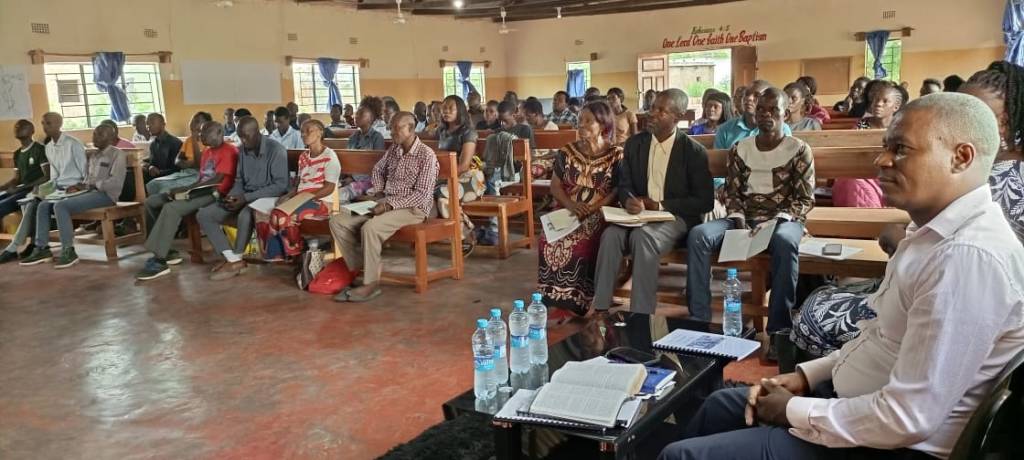
The Need of Christian Leadership
The great need in Africa is Leadership, – Christian leaders who have a deep knowledge of the Scriptures, but also the character shaped by those Scriptures. Someone has well said that “everything rises and falls on leadership.” The future of gospel advance on this continent of 1.5 billion people rests upon the church in Africa, and those churches need faith-filled, Spirit-empowered, competent leadership.
I have found John Piper’s preaching on gospel missions to be both encouraging and motivating, as well as rebuking, in my pursuit of Christ. With apologies in advance to John Piper, some years ago I listened to a sermon he preached on Barnabas and jotted down notes. Along the way, I added my thoughts, but I’m not sure where Pastor John’s thoughts end and mine begin, hence the apology.
The Nature of Christian Leadership
God calls Christian leaders to proclaim and live the truth of God’s word and to raise up other leaders who will serve the gospel and the church. Christian leadership is fundamentally about transformation and development.
A leader is someone who takes risks on behalf of the leader they are developing. More broadly, to the degree that you shape others toward the image of Christ, you are a Christian leader. This definition shifts our understanding from positional authority to a life-shaping influence in the lives of others.
Understanding leadership as transformational influence rather than positional authority naturally leads us to ask: what kind of leaders does the church actually need today?
A Vision for Christian Leadership
What the church truly needs worldwide is Spirit-filled, Bible-saturated, Christ-exalting, self-abasing, untiring, persevering leaders who exert deep, broad, life-changing influence for Jesus Christ. It is the task of the church to raise up those leaders!
Patrick Johnstone, in his work Operation World, identifies a critical gap in Christian leadership worldwide:
“Leadership is the key… There is a worldwide lack of men and women truly called of God and deeply taught in the Scriptures to lead the churches—people willing to suffer scorn, poverty and the shame of the Cross for the sake of the Saviour who redeemed them. Those who accurately and effectively expound the Scriptures are few, especially in areas where the churches are growing rapidly.”
This observation highlights not only a numerical shortage of gospel workers but also the need for leaders of a specific character and commitment. Fortunately, Scripture provides us with a compelling example of exactly this type of leader, a missionary named Barnabas, whose life demonstrates how Spirit-filled character translates into effective missionary leadership.
A Model for Christian Leadership
The apostle Barnabas serves as an admirable example of a Christian leader sent to do mission work on behalf of the church. His character flowed from being filled by the Holy Spirit. Piper notes that his leadership was characterized by six key demonstrations of goodness and faith:
1. Empathy Toward Outsiders (Acts 11:22-24)
Barnabas showed genuine care and concern for those on the margins, understanding their position because faith remembers the wonder of once being an outsider who God has now accepted. The Christian leader notices the marginalized, the downtrodden, the quiet young man sitting by himself, the shy young mother who tries to escape out the door immediately after the service. The Christian leader also notices groups of people who have been marginalized in terms of hearing the gospel of Jesus… and does something about it.
2. Submission to God’s Call Through the Church (Acts 11:22; 13:1-3)
He yielded to God’s calling as it came through the church fellowship, demonstrating faith that risks everything on the missionary promise of Matthew 28:19-20 and trusts in Christ’s presence with him in the mission “to the end of the age.” He does not run ahead of the church but submits and is accountable to the church, understanding that they have the biblical authority in the sending.
3. Vision of God’s Grace in an Imperfect Church (Acts 11:23)
Barnabas possessed the ability to see God’s grace at work even in churches where there were difficulties and struggles. He fixed his eyes of faith on Christ, confident that Christ would indeed build His church amidst the social pressures, human weaknesses, and cultural opposition, and this enabled him to recognize the grace at work, wherever it appeared.
4. Joy Over God’s Grace in Others’ Lives (Acts 11:23)
He not only recognized grace but actively rejoiced in it when he saw it demonstrated in other people’s lives. A Christian leader celebrates the little victories of grace in the lives of those who have been converted. He sees the imperfections and the room for growth without becoming critical, overjoyed with the steps of faith and obedience that are evident in the growing believer.
5. Exertion for the Saints’ Perseverance (Acts 11:23; 14:21-22)
Barnabas worked diligently to encourage believers in their spiritual growth. He knew that faith must be strengthened to withstand the temptations of the flesh and the spiritual attacks of Satan. He works for the perseverance of faith and obedience in the lives of those who have trusted Christ, knowing that they must persevere and that they will persevere. He exhorts with confidence of the already, not yet.
6. Trustworthiness with Others’ Money (Acts 4:36-37; 11:29-30)
He was reliable in handling the finances entrusted to him by the churches. The Christian leader has faith in God. He is confident in God’s care and provision, thus free from covetousness. He is not a “lover of money” because He is a lover of God. The mission of God will be carried out, but only by trustworthy leaders – this begins in the personal life, is demonstrated in the local church, and then is implemented on the mission field.
These six characteristics of Barnabas might seem like an overwhelming standard, but Luke’s description of him reveals the secret source from which all these qualities flow.
The Spirit-Controlled Faith of Christian Leadership
Luke’s assessment of Barnabas provides the key insight: “He was a good man full of the Holy Spirit and faith” (Acts 11:24). The filling of the Holy Spirit was the underlying cause of his goodness—all six demonstrations of his leadership excellence flow from this spiritual foundation.
Each characteristic reveals how Spirit-controlled faith shapes leadership:
- Faith creates empathy by remembering our own need for acceptance
- Faith enables submission by trusting in God’s promises
- Faith develops vision by being attuned to grace
- Faith produces joy by treasuring what it has received
- Faith motivates perseverance by applying the sovereignty of God
- Faith conquers greed by trusting in God’s unfailing love
This connection between faith, the Spirit’s filling, and practical leadership effectiveness shows us that the kind of leaders the church desperately needs are not produced by human effort alone, but by divine transformation.
Conclusion
Barnabas is the kind of leader the church in Africa needs today. His goodness was rooted in faith and empowered by the Holy Spirit. His life demonstrates that effective Christian leadership flows from spiritual depth rather than technique or charisma. The church’s greatest need is not for more programs or strategies but for more leaders like Barnabas—men and women filled with the Holy Spirit and faith, willing to take risks for the gospel to be proclaimed, and willing to labor for the spiritual maturity of others in Christ.


 Zambia Hunt
Leave a comment