Disability Access and CABU Philosophy
Introduction
Persons with disabilities in Africa are most often seen as a curse, not a blessing. In research for a paper for the International Journal of Special Education, Cynthy Haihambo wrote:
The majority of research participants acknowledge a belief that any occurrence of disability was linked in some way to witchcraft. Among the 62 parents with disabilities, 49 respondents mentioned some sort of witchcraft as a cause for disabilities. (Approximately 79%)
There were largely two theories related to this belief. The first theory is that jealous rivals bewitched the family that bears a child with a disability. These rivals could be neighbors, but in some cases, they could also be members of the extended family. This theory was mentioned most often in relation to disabilities that were acquired after birth.
The second theory is that the family that bears a child who is born with disability practiced witchcraft and failed to fulfill all the requirements of the witchdoctor. This theory was linked more with congenital disabilities.
Because of the association of disability with witchcraft, persons with disabilities and their families tend to be isolated, rejected or even harmed. Some of the elders revealed that, many years ago, children born with visible disabilities were killed immediately after birth or were left in the field to die naturally because of this association with witchcraft. However, others noted that they pitied people with disabilities because of the scourge of witchcraft.1
Cultural Perceptions vs. Biblical Truth About Disability
Our task at Central Africa Baptist University is to carry out God’s mission for God’s glory, motivated by love and gratitude.
In His earthly ministry, Jesus carried out the mission of God the Father, and He had such clarity of mission that He could evaluate when the work He was tasked to carry out was complete (Jn. 17:4). The Apostle Paul had a similar clarity of mission. In Romans 15, Paul announced that there was no longer any room for him in the region from Jerusalem to Illyricum because the gospel had been preached there. His mission was to take the gospel to those who had not heard, so that those who had not seen the truth could also see and believe (Rom 15:19).
God has called us to labor for His cause and entrusted a mission to us at CABU. Our mission is to train servants of God for the church, equipping and engaging them in proclaiming the gospel and teaching all who believe to obey Jesus. Training for gospel outreach through the local church involves identifying and preparing men and women to reach the least-reached people, wherever they may be, and regardless of their background. You can see examples of how this mission has been carried out in our ministry at CABU.
An underserved area for gospel outreach in the Zambian church was to men and women in uniform serving in the Zambia Army, Police, ZNS, Air Force, Prisons, and Special Forces. We saw the need as an opportunity to reach less-reached communities with the gospel, and we launched our chaplaincy ministry in 2010.
In 2016 we leaned into developing a School of Education where Christian teachers can be equipped with a biblical worldview and develop a heart for Christ and his gospel mission. There are an estimated 651 million children in Africa under the age of 17 years, and 223 million of those are primary-age children. 2
And how will the @ 200,000 Deaf in Zambia3 ever hear of the saving grace of the Lord Jesus if we do not intentionally make a plan to learn their language and reach them with the gospel? Local churches need to be equipped with sign language speakers and interpreters who can translate sermons into the language of the deaf. This mission also drives our long-term goal and commitment to accepting qualifying deaf individuals into our university programs in the School of Bible and the School of Education.
At Central Africa Baptist University, we are preparing servant-leaders in Africa for Great Commission Living. This is not primarily an academic or educational goal; it is not a social or economic goal, but primarily a theological and ministry goal. Education is the tool we use to make disciples.
Our mission at CABU is to prepare disciples to advance the gospel to every tribe, tongue, and people:
- Who are the marginalized people?
- Who are the ignored people?
- Where are the people who need to know Christ?
It is challenging to find reliable estimates of the number of persons with disabilities in Zambia. One older estimate in 2016 was that two million people in Zambia suffer some identifiable physical, mental, or emotional disability.4 Worldwide, that number may be as large as one billion people affected by disability. Mostly, these people are misunderstood, devalued, and deeply wounded.
Where are the disabled in our evangelical churches? Why are they mainly missing from our churches? How will the gospel reach those who suffer from physical disabilities?
There are worldview implications to this question. Across Africa, it is commonly believed that disabilities are a punishment for evil deeds or because of witchcraft. These cultural religious beliefs influence the response to those with disabilities, even though some educated urban dwellers in Africa reject the underlying premise.
Swaziland Disability Policy, “Factors that have an impact on disability include… the attitude of other individuals and of society that perceive those who have a disability as different persons; and do not see them as human beings with equal rights and responsibilities.”
- Albinism
- Deafness
- Blindness
- Physical handicap – lameness
- Mental disabilities
The disciples also viewed disability through the lens of religious and cultural assumptions. In John 9:1-25, Jesus and his men encountered a beggar who was born blind. The disciples asked Jesus, “Rabbi, why was this man born blind? Was it because of his own sins or his parents’ sins?” Jesus was quick to clarify that his blindness was not due to his sin or the sin of his parents, but that disability was to display the glory of God. God is still glorifying himself through the disabled.
We reject these cultural assumptions because a biblical worldview acknowledges that all people are created in the image of God and, as image bearers, have great worth!
Genesis 1:26-27 26 Then God said, “Let us make man in our image, after our likeness. And let them have dominion over the fish of the sea and over the birds of the heavens and over the livestock and over all the earth and over every creeping thing that creeps on the earth.” 27 So God created man in his own image, in the image of God he created him; male and female he created them.
Jesus’s Heart for People with Disabilities
We reject these cultural assumptions because Scripture is filled with illustrations and examples of gospel ministry to, with, and by the disabled. Consider this.
- Paul had a physical disability, which some believe was poor eyesight.
2 Cor. 12:7 So to keep me from becoming conceited because of the surpassing greatness of the revelations, a thorn was given me in the flesh, a messenger of Satan to harass me, to keep me from becoming conceited. 8 Three times I pleaded with the Lord about this, that it should leave me. 9 But he said to me, “My grace is sufficient for you, for my power is made perfect in weakness.” Therefore I will boast all the more gladly of my weaknesses so that the power of Christ may rest upon me.
- Zacchaeus was a very short man – and may have unaccepted in Jewish culture because of his stature, he certianly was rejected by his culture (Lk. 19:2-8) for being a tax collector and thus a traitor to Judaism.
- Jesus taught that the Kingdom of heaven would be filled with the lame, blind, and poor from the highways and byways because the Jews had rejected the kingdom. (Lk. 14:15-24)
- Jesus reached out to those with disabilities and welcomed them into his presence! In fact, 25 of his 34 miracles were people with disabilities. Jesus sets an example for us of how we interact with the disabled:
- Compassion – Jesus touched lepers as he healed them – touch communicates acceptance (Mt. 8:1-3).
- Spiritual concern – the greatest disability is to die in your sin and spend eternity in hell.
- The expectation of fruitful ministry – the disabled can testify of God’s saving grace to the world. ILL: Nick Vujacic was born with no arms or legs, and serves Christ as internationally known evangelist.5
- Jesus gave the disabled his time. He was gentle and welcoming and gave them personal attention affirming their dignity. Many disabled people were brought to him, and he healed them all (Mt. 4:23-25, 15:30-31). The blind shouted and cried in desperation, and Jesus heard their cry through the ministry and the noise (Mt. 20:29-34) and gave them his personal attention and time.
- Jesus was always concerned for the spiritual needs of the disabled. The condition of the heart was more important to Jesus than the condition of the body that the person could walk, see, or hear.
- Centurion’s faith (Mt. 8:5-13).
- Faith of the two blind men (Mt. 9:27-31).
- Faith of the four friends and forgiveness of the paralytic sins. (Lk. 5:20).
CABU’s Mission to Include and Equip the Disabled
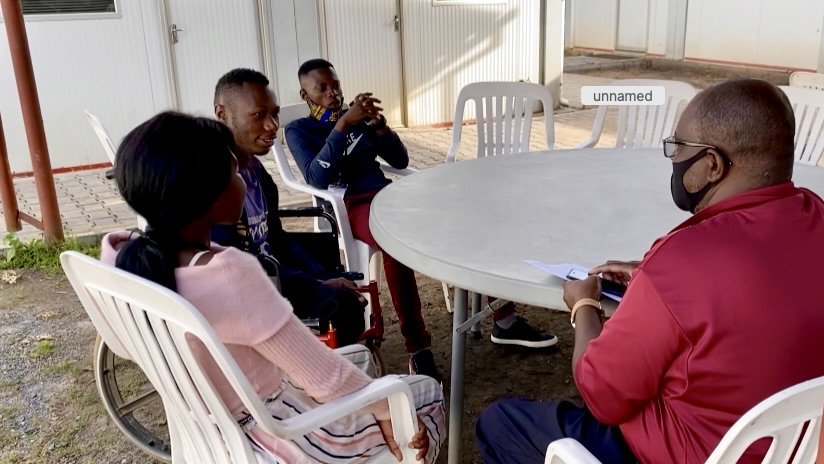
The question is, why do we not have many disabled persons in our churches? How can we include those with disabilities who have the academic ability and share a desire to be trained as servant leaders for Great Commission living?
At CABU, we are committed to breaking down barriers and building bridges for the gospel that bring disabled people to the love and hope found in Jesus Christ. We will train future church leaders to have eyes and hearts to see all people in the community who need Jesus! We will train servant-leaders for great commission living by helping them discover and develop the spiritual gifts that God has given them to serve the church. Some of these servant-leaders will come to us with disabilities.
When we see the disabled through the eyes of Jesus Christ we see them as a blessing and not a curse! At CABU we are committed to finding ways to train servant leaders to minister to the disabled, and to equip and empower the disabled themselves to serve Christ’s church in Africa.
- CULTURAL BELIEFS REGARDING PEOPLE WITH DISABILITIES IN NAMIBIA:
IMPLICATIONS FOR THE INCLUSION OF PEOPLE WITH DISABILITIES. Cynthy Haihambo University of Namibia, Elizabeth Lightfoot University of Namibia and the University of Minnesota. https://files.eric.ed.gov/fulltext/EJ909038.pdf ↩︎ - https://www.statista.com/statistics/1226211/population-of-africa-by-age-group/ ↩︎
- https://www.icphs2019.org/the-deaf-population-in-zambia ↩︎
- https://zambia.co.zm/news/headlines/2017/11/25/zambia-has-2-million-people-with-disabilities/ ↩︎
- https://nickvujicic.com/ ↩︎

 Zambia Hunt
Leave a comment