
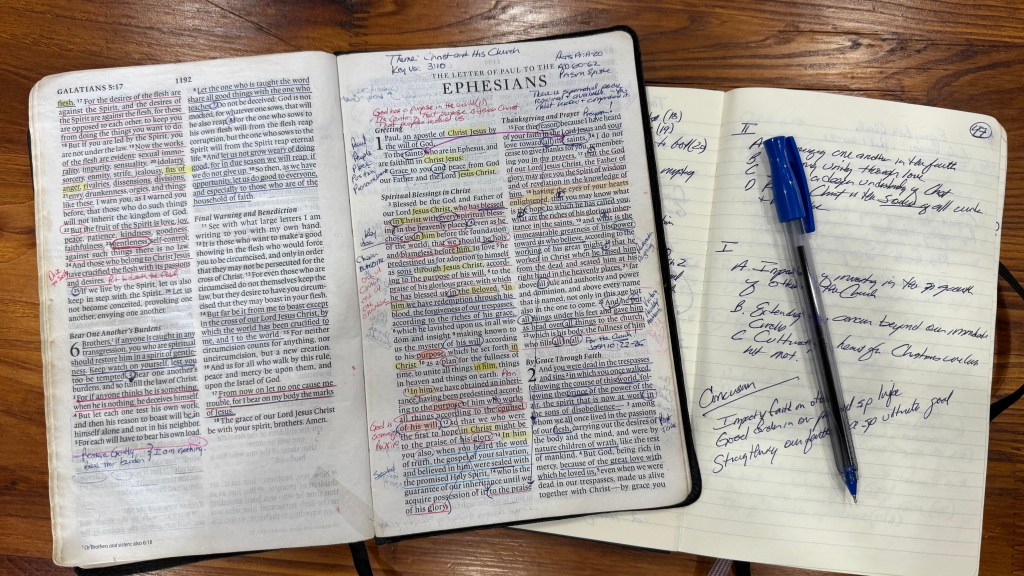
Paging through one of my retired copies of the Scriptures, I noted that the pages bearing the most wear, stained by frequent handling, were in Romans, Ephesians, Philippians, 1 Timothy, 2 Timothy, and Titus. Also, there are clear signs of wear, but not as much as in James, 1 and 2 Peter, and 1 John. Upon flipping through, I note that the first double-page spread with no pen mark is Exodus 26, with 4 clean pages in Leviticus, as well as Joshua 20, and a few in Judges, etc.
This worn Bible, used from December 2006 to June 2016, is a journal of my own spiritual journey and walk with God. How much has God done in my life through the Word? Much of it is imperceptible, I’m certain. It is not the grand light-bulb moment in the Word but the faithful dripping of Scripture into my life that has had the most effect.
Is it any wonder that Satan and my flesh war against spending time in the Word? Too often I’m tempted to get busy with other things and not spend time in the Scriptures, or approach it as something to get done and checked off my daily to-do list. Being in the Word, even with misplaced motive is better than not being in the Word at all, but how much better is the slow, unhurried, thoughtful suntering through the Scriptures with facination and imagination that best suits this spiritual discipline.
Early in my Christian walk I was helped by the late Howard Hendricks to approach the Scriptures in my personal devotions by asking questions of the text. This has become a way of life for me. Perhaps this summary of his notes will help you as they have me:
Bible Study Method: “Living by the Book”1 Dr. H. Hendricks’ Approach
Start with Questions
Ask the fundamental questions: Who, What, Where, When, Why, and How? These form the foundation of understanding any biblical passage.
Six Key Things to Look For:
1. What’s Emphasized
Scripture shows importance through several means. Notice how much space is devoted to a topic—more coverage typically indicates greater significance. Look for explicitly stated purposes, like John’s declaration that his Gospel was written “that you may believe” (John 20:30-31) or Luke’s organized account (Luke 1:3-4). Pay attention to the sequence of events, as the order often reveals priority and meaning, such as belief preceding baptism in Acts 2:41 and 8:36-38. Watch for progression from general principles to specific applications.
2. What’s Repeated
Repetition signals emphasis in Scripture. Notice recurring ideas, phrases, or words that appear throughout a passage or book. Psalm 136 repeats “For His mercy endures forever” in every verse, while Hebrews 11 repeatedly uses “by faith” to demonstrate the power of trust in God.
3. What’s Connected
Scripture often moves from broad concepts to specific examples, helping readers understand general principles through concrete illustrations. Look for question-and-answer patterns, like those in 2 Corinthians 6:14-17 or Jeremiah 32:27. Notice cause-and-effect relationships, such as in Hebrews 12:6 and 11, where God’s discipline leads to growth and peace.
4. What’s Similar (Comparisons)
Watch for comparison words like “like” or “as,” which help explain unfamiliar concepts through familiar ones. Sometimes comparisons are conceptual rather than explicit—John 3 compares physical birth with spiritual birth to explain being “born again.”
5. What’s Different (Contrasts)
The word “but” often signals important contrasts that highlight key truths. Ephesians 2:1-5 uses contrast to show the dramatic difference between spiritual death and life in Christ.
6. What’s Realistic
Engage your imagination to understand the human dimension of Scripture. Put yourself in the shoes of biblical characters—feel their emotions, understand their circumstances, and consider their motivations. This helps Scripture come alive and makes its lessons more personally meaningful.
The Goal
Asking questions transforms Bible reading from a passive activity to active discovery, helping you uncover the rich truths God has embedded in His Word.
If you know Jesus, you are on your own spiritual journey with Christ. That journey must be grounded in the Scriptures. Get a notebook and pen and your Bible and get going! You will be glad that you did!
- From personal notes edited for readabilty by claude.ai ↩︎




 Zambia Hunt
Leave a comment