

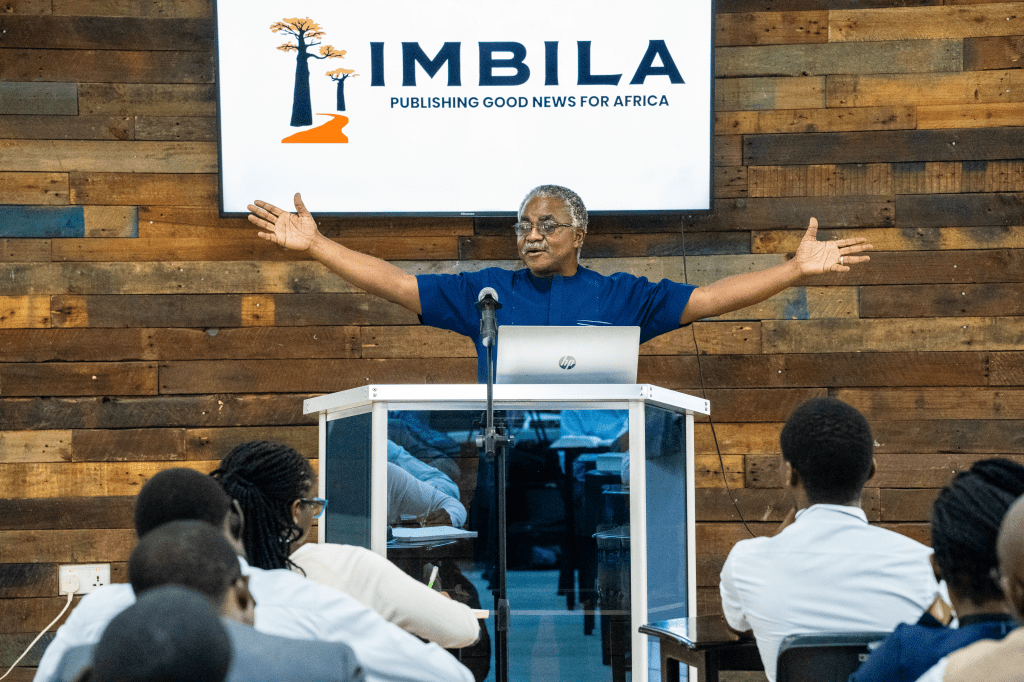
From a Presentation By Pastor Ronald Kalifungwa at the Imbila Publishers Writer’s Conference Edited from presentation notes with help of Claude.ai

Introduction
The landscape of Christian literature has long been dominated by Western voices, leaving a noticeable gap in perspectives from other parts of the world. This gap is particularly pronounced in Africa, where despite rapid church growth, indigenous Christian literature remains scarce. The necessity for African Christian authors and publications has never been more apparent, as the church in Africa continues to expand without a corresponding growth in locally produced theological resources.
African Christian “Necessitators”
Who are the individuals positioned to address this critical need? I call them “necessitators” – those who recognize the necessity and step forward to meet it.
An African Christian necessitator is someone who shares in the cultural values and experiences of the African continent while approaching life and writing from a distinctly Christian worldview. Their thinking is shaped by Christian principles – what theologians might call a “noetic structure” informed by biblical truth.
These necessitators don’t simply appear; they must be intentionally developed through our churches, seminaries, conferences, and spiritual retreats. The cultivation of African Christian authors requires deliberate investment from our existing institutions.
The path forward is clear but challenging. African Christian authors must rise to meet the necessity of creating indigenous theological resources that speak to both African realities and universal Christian truths.
Understanding the Current Reality
To address this need effectively, we must first understand the current landscape:
The church in Africa is experiencing unprecedented growth, yet many African Christians remain surprisingly uninformed about theological matters. This is not for lack of interest but rather for lack of accessible, contextually relevant resources.
African voices are significantly underrepresented in global Christian publishing. This underrepresentation is not primarily due to exclusion by Western publishers but because too few Africans are writing. As theologian John Mbiti astutely observed, the African church has been fed upon a diet of Western theology, which, while valuable, is not always pertinent to African contexts and concerns.
When seeking resources by African Christian leaders, one might encounter historical figures like Cyprian, Augustine, or Tertullian, but contemporary African voices are rarely found in libraries or bookstores. This absence creates a disconnect between the lived experiences of African Christians and the theological resources available to them.
Why We Don’t Read African Christian Authors
Even when African Christian literature exists, it often goes unread by African Christians themselves. There are several reasons for this phenomenon:
- A crisis of confidence: Many Africans have internalized the belief that imported goods – including intellectual resources – are inherently superior to local productions. This mindset leads to the marginalization of valuable African Christian literature and allows Western writers to document African history and stories by default. To be clear, this is not the fault of Western authors but a responsibility we have abdicated.
- Uncritical acceptance of imported theology: We have often failed to contextualize theology within our African setting, instead accepting missionary teachings wholesale. There is a tendency to equate Western traditions with Christianity itself, leaving us hesitant to adapt or “tweak” these traditions out of fear of compromising the faith.
- Lack of critical engagement: When presented with Western Christian perspectives, there is often minimal critical evaluation or challenge from African theologians, leading to a one-sided theological conversation.
- Insufficient attention to African challenges: Many theological works fail to address the unique challenges facing African Christians, creating a relevance gap that diminishes their impact.
Biblical Foundations for Christian Writing
Before addressing how to overcome these challenges, we should establish the biblical basis for Christian writing. Scripture provides several motivations for the written word:
Writing serves as a memorial. In Exodus 17:14, God instructs Moses to “Write this on a scroll as something to be remembered.” The written word preserves significant moments and divine encounters for future generations.
Writing preserves knowledge across time. Psalm 102:18 speaks of writing “for a future generation,” ensuring that truth endures beyond a single lifetime.
Writing instructs others in godly living. Deuteronomy 6:6-9 commands God’s people to write His words on doorframes and gates – making truth visibly accessible to all.
Writing captures what is necessary. John 21:25 acknowledges that not everything need be written, but some truths must be preserved in written form for the good of God’s people.
Written words transform lives. 2 Timothy 3:16 affirms that “All Scripture is God-breathed and is useful for teaching, rebuking, correcting and training in righteousness.” The written word is a divine tool for spiritual formation.
Writing extends our reach. In Revelation 1:11, John is instructed to “Write on a scroll what you see and send it to the seven churches.” Writing allows truth to travel beyond geographical and temporal boundaries.
Drawing Inspiration from Existing African Christian Writers
Though few in number, there are African Christian authors whose work can inspire a new generation of writers. Unfortunately, many remain unknown to the broader world, and some who have achieved prominence promote theological perspectives at odds with sound evangelical teaching.
We must identify, support, and promote those African Christian authors who faithfully communicate biblical truth. This support can take practical forms: purchasing their books, recommending them to others, and using their work in our teaching and preaching. Perhaps most importantly, we can join their ranks by becoming writers ourselves.
Areas Needing African Christian Voices
Several specific domains would benefit greatly from increased African Christian literary contributions:
African narrative preaching: Many African cultures have rich oral traditions that naturally lend themselves to narrative preaching. This approach needs proper biblical grounding to reach its full potential.
Christian storytelling: Africa abounds with stories that, when interpreted through a Christian lens, can powerfully communicate biblical truth in culturally resonant ways.
Contemporary challenges: Modern issues facing African societies need to be addressed from a distinctly African Christian perspective.
Theological development: Where are the quotations from “African Puritans”? We need voices of comparable theological depth emerging from African soil.
Other pressing needs include:
- Biographies of African Christian leaders
- Theological works engaging African contexts
- Documentation of African church history
- Accounts of missions work by Africans within Africa
- Thoughtful engagement with cultural issues
Cultural Engagement through Christian Writing
A common barrier to African Christian writing is a narrow understanding of culture. We need to move beyond simplistic rejection or uncritical acceptance of cultural elements toward what might be called “cultural redemption.”
Christianity should not merely borrow cultural forms from the West but should influence and transform African cultures from within. As Christians, we should be biblically grounded influencers of culture, recognizing that while Africa makes us African, Christianity connects us to believers worldwide.
African Christian authors should write in ways that contribute to the global theological conversation while remaining authentically African in perspective.
Overcoming Barriers to African Christian Writing
Several obstacles have historically prevented African Christians from writing, and these must be consciously resisted:
Colonialism suppressed many African narratives, replacing them with external interpretations. We must resist approaches where others tell our stories for us.
There is a persistent myth that Africans, coming from oral traditions, cannot effectively write. This mindset must be rejected as we embrace written communication alongside oral forms.
Technical barriers often discourage potential writers. Remember that one need not be a natural writer to produce valuable content – editorial assistance can help polish important ideas.
Conclusion
The path forward is clear but challenging. African Christian authors must rise to meet the necessity of creating indigenous theological resources that speak to both African realities and universal Christian truths. The task requires confidence, contextual awareness, critical thinking, and cultural engagement.
Most importantly, it requires action. If you are an African Christian with insights to share, do not wait for perfect conditions or complete training. Begin where you are, with what you have. Write something! The African church – and indeed the global church – needs your voice.
The necessity is great, but so is the opportunity. May God raise up a generation of African Christian authors who will enrich the church with perspectives too long absent from the theological conversation.
You can reach Pastor Ronald Kalifungwa at rkalifungwa@gmail.com




 Zambia Hunt
Leave a comment