
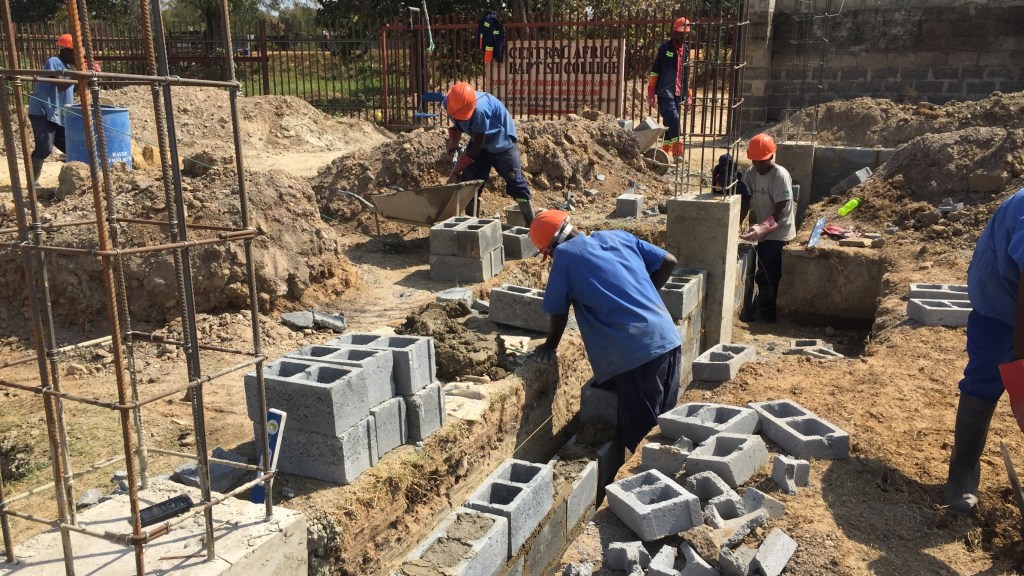
As I drive through the streets of our cities and towns, something has been weighing heavily on my heart. Everywhere I look, I see churches defined by their physical structures – buildings, sophisticated sound systems, and modern amenities. Yet, in the midst of all this external development, I fear we’re losing sight of a fundamental truth about Christ’s church: it was never meant to be about the structures or systems but about the supernatural work of Jesus Christ in building His people.
This truth hit home for me recently through two encounters that illustrate a growing crisis in our understanding of church growth and planting. I was driving between Ndola and Kitwe when a conversation in the car caught my attention. As we passed the bustling market near the Zesco Power Station, one of my fellow travelers turned to another and enthusiastically declared, “We should plant a church here.” My heart initially leaped at this apparent passion for evangelism, but what followed stopped me cold: “It’s easy – we just need an amplifier and speakers for singing and dancing.” In that moment, I realized how far we’ve drifted from the biblical understanding of church planting.
But this wasn’t an isolated incident. Just two weeks ago, several Kitwe Church elders surveyed potential church planting locations in the Northern Province. During their visit, they met with a local pastor who shepherds a congregation in a city of 200,000 souls. When we asked about his church’s involvement in planting new congregations, his response left us stunned: “No, we’ve never planted – we don’t have speakers or a sound system.” The implication was clear and troubling – in his mind, and in the minds of many others, the absence of equipment meant the absence of ability to advance the gospel.
Perhaps even more concerning are the voices of defeat I consistently hear from church planters and their supporting partners. These voices, laden with misplaced certainty, declare that healthy, indigenous churches simply cannot take root in rural areas. They point to poverty, illiteracy, or various other challenges as insurmountable barriers to church growth. When we send out planters who have already decided that their task is impossible, should we be surprised when the work fails to flourish?
These stories and situations point us back to an unshakeable truth that must be woven into the very DNA of every church, every church planter, and every new congregation: the promise that Christ Himself declared, “I WILL build my church, and the gates of hell shall not prevail against it.” This is the very foundation of our mission and the bedrock of our confidence in church planting and growth.
To truly understand the power and implications of this promise, we need to journey back to its original context. Picture yourself standing with Jesus and His disciples in Caesarea Philippi, about 40 kilometers north of the Sea of Galilee. This wasn’t a random location for such a momentous declaration. Jesus deliberately chose this spot, a place that stood at the edge of Jewish territory and served as a gateway to the Gentile world. They stood before the Cave of Pan, known ominously as the “Gates of Hades,” a place steeped in pagan worship and believed to be an entrance to the underworld.
In this setting, surrounded by the visible symbols of worldly power and false gods, Jesus posed the most crucial question in all of human history: “Who do people say that the Son of Man is?” The disciples’ initial responses reflected the popular opinions of their day: “Some say John the Baptist, others say Elijah, and others Jeremiah or one of the prophets” (Matthew 16:14). These weren’t necessarily negative responses – they attributed great honor to Jesus, placing Him among the greatest of the prophets. But they missed the mark entirely.
Then Jesus made it personal, turning to His disciples with the question that every human being must eventually answer: “But who do you say that I am?” The emphasis in the original Greek is striking – “But you (ὑμεῖς), who do you say I am?” This wasn’t about popular opinion anymore; this was about personal conviction.
Peter’s response, inspired by divine revelation, cut through all the confusion and half-truths: “You are the Christ, the Son of the living God” (Matthew 16:16). This wasn’t merely a good answer or a thoughtful theological statement – it was a divine revelation of eternal significance. As Jesus declared, “Blessed are you, Simon Bar-Jonah! For flesh and blood has not revealed this to you, but my Father who is in heaven” (Matthew 16:17).
This exchange sets the stage for Jesus’ momentous declaration about building His church. Standing before the entrance to the cave of Pan, god of the underworld, surrounded by the symbols of worldly power and false worship, Jesus made an announcement that would echo through the centuries: “You are Peter, and on this rock I will build my church, and the gates of hell shall not prevail against it” (Matthew 16:18).
Notice the profound implications of this statement. First, notice who’s doing the building – “I will build.” This isn’t about our strategies, our resources, or our abilities. The church’s growth depends not on human ingenuity but on Christ’s divine work. Second, notice the possessive pronoun – “my church.” The church belongs to Christ alone, not to any human leader, denomination, or organization. Finally, observe the guaranteed outcome – “the gates of hell shall not prevail against it.” No opposition, whether spiritual or physical, can prevent Christ’s church from advancing.
Throughout Scripture, we see this same truth reinforced through various metaphors describing Christ’s relationship to His church. He is the Shepherd-King who leads and protects His flock (1 Peter 5:4). He is the owner who purchased the church with His own blood (Acts 20:28). He is the head of the body, directing and coordinating every movement (Colossians 1:18). He is the cornerstone upon which the entire structure is built and aligned (Ephesians 2:19-20).
This understanding fundamentally transforms how we approach church planting and growth. When we truly grasp that Christ is the builder of His church, our focus shifts from external resources to spiritual foundations. While sound systems and buildings can be useful tools, they are never prerequisites for church growth. The promise that Christ will build His church frees us from the paralysis of inadequate resources and empowers us to move forward in faith.
Moreover, this truth compels us to reject the mindset of impossibility that so often plagues church planting efforts. No location is too poor, too hostile, or too challenging for Christ to build His church. When we declare certain areas “impossible” for church planting, we’re not just displaying a lack of faith – we’re directly contradicting Christ’s promise.
This brings us to our role in Christ’s building project. We are not the architects – we are the instruments in the Master Builder’s hands. Our task is not to build the church ourselves but to surrender ourselves fully to Christ’s work through us. This requires a fundamental shift in how we think about church planting and growth.
Some of us have compromised truth for comfort, settling for less than God’s best because we’re convinced that “our people” or “our area” can’t support a thriving church. We’ve been looking at our limitations instead of Christ’s limitless power. Others have reduced church planting to a mere technical exercise, focusing on equipment and logistics while neglecting the spiritual foundations that Christ emphasized.
The time for such compromises and excuses is over. The same Christ who declared “I will build my church” stands ready to work through you today. The gates of hell cannot prevail against His church – the only thing that can hold back His work is our unwillingness to be used by Him, our unbelief that He will do exactly what He says (Matthew 13:58).
Let me pose a simple but profound question: Will you be a faithful instrument in the Master Builder’s hands? Will you trust His promise enough to step out in faith, even when the resources seem inadequate and the obstacles appear insurmountable? Will you allow Him to work through you to build His church here in Zambia and across Africa, regardless of the cost?
The promise remains unchanged – Christ WILL build His church. The only question is whether we will participate in this divine building project or stand on the sidelines, held back by our fears and limitations.
Remember, the church’s growth doesn’t depend on sound systems, structures, or socioeconomic conditions. It depends on Christ’s unfailing promise and power. And that promise is as true today as it was when Jesus first spoke it in Caesarea Philippi. Let’s move forward in faith, confident that the Lord will indeed build His church.

 Zambia Hunt
Leave a comment