
Darrell Champlin
Introduction
God used Darrell Champlin in my early years of ministry. His view of God, his love for the Scriptures, and undying passion to see the world know of Jesus Christ had a profound impact on my life and ministry. After his death, Darrell’s family sent me some of his old typewritten notes. Contained in that packet of papers was a lesson titled: ETERNITY IN THEIR HEARTS: A GOD SHAPED VACUUM IN EVERY CULTURE. I have tried to take his notes and put it into a form that would be helpful for us… here it is:
The Premise:
Romans 1:18-25 provides a foundational understanding of what we might call a “God-shaped vacuum” in every culture. This concept is beautifully illustrated through various cultural examples. This God-shaped vacuum in the heart of every culture, is created and nourished by the Creator Himself.

The Sodom Factor: Man’s Rebellion Against God
Despite this innate knowledge of God, we observe what can be called “The Sodom Factor.” This concept, derived from Acts 14:16-17 and Romans 2:21-27, demonstrates that humanity’s Adamic nature has consistently rebelled against the truth of God. It’s a sobering reminder of our inherent tendency to turn away from our Creator.
The Abraham Factor: The Power of Special Revelation
In contrast to the Sodom Factor, we have “The Abraham Factor” of Special Revelation. This principle, rooted in Romans 1:16-17, affirms that the Gospel of Jesus Christ when preached, taught, and ministered one-on-one, is the only way to conquer human rebellion and bring light to those who naturally reject it.
To illustrate the difference between general and special revelation, we can use the analogy of light:
- Ambient light (photons wandering about) represents general revelation.
- Laser light (photons marching in order) represents special revelation.
The Melchizedek Factor: God’s Extra-Biblical Revelation
The story of Melchizedek in Genesis 14:18-20 provides a fascinating glimpse into how God has revealed Himself outside of the Biblical narrative. Let’s explore this in detail:
- The Abrahamic Covenant (Genesis 12:1-3) was a milestone in Special Revelation, promising blessing to the entire world.
- By Genesis 14, Abraham was deep in the midst of barbarous, idol-worshipping peoples outside the ken of the God of Abraham. (Gen. 14:19 plus thirty other ethnic groups from Egypt to Chaldea mentioned in the first 36 chapters of Genesis.)
- Deeper in Canaan, Abram found Salem. Salem was a Canaanite word which became “Shalom” in Hebrew and “Salaam” in Arabic. Eventually, “Salem” (Peace) was added to “Jeru-” (foundation of) to make the name “Jerusalem.”
- There Abram found Melchizedek (Melki [king] of Zadok [righteousness]) at the valley of Shaveh, who brought bread and wine from Salem. (Gen 14:18-19)
- Melchizedek is priest of El Elyon, the most high God–the Canaanite word for Jehovah Himself. Hebrews 6:20, 7:4-10, 17 explain how great Melchizedek was, and Psalm 110:4 gives David’s prophecy that Jesus would be a priest forever after the order of Melchizedek.
- Abram, recognizing Melchizedek’s relationship to God, receives his blessing and gives him tithes of all. (Gen. 14:19,20,22)
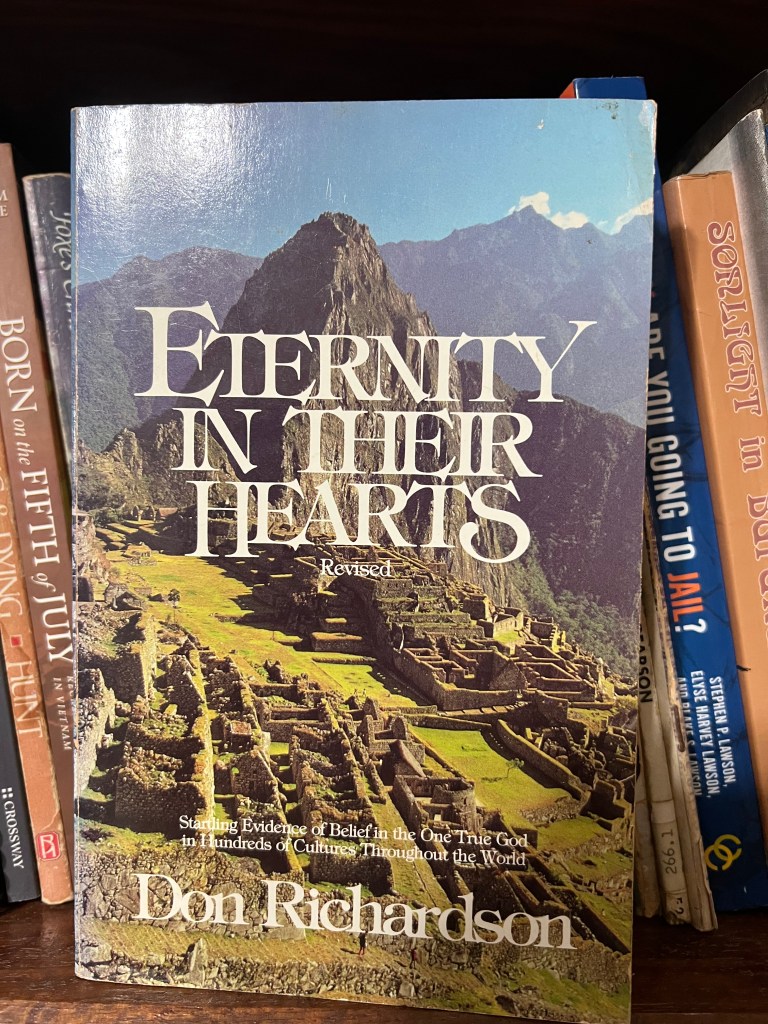
Eternity in Their Hearts: Cultural Examples
Don Richardson’s book “Eternity in Their Hearts” provides numerous examples of how God has revealed Himself in various cultures:
1. Pachacuti of the Incas (1438-1471 AD)
Pachacuti, King of Incas, discovered the God of Heaven and worshiped Him! He left the Inca god Inti (the sun) because that god never did anything original and could be dimmed by clouds. Pachacuti discovered that he was worshiping a mere created thing, rather than the Creator. He aligned this knowledge with his own culture’s almost extinct memory of Virachocha, the Lord, the omnipotent Creator of all things.
2. The Santal People of Calcutta (1867)
Lars Skrefsrud discovered that the Santal people were immediately electrified by the Gospel message, saying that Thakus Jiu (the genuine god) had not forgotten them. Their creation story was similar to Genesis’, including the temptation by a being named Lita. As a result, many people have become believers over the years, with 100,000 under Skrefusrud’s Santal Mission alone.
3. African Evidences
- Ethiopia’s Gedeo People: Warrasa Wange’s prophetic dream of men bringing a message from Magano, their ancient God.
- The Mbaka People of Central African Republic: Their belief in Koro, the Creator, and the expectation of His messengers.
4. The Karen People of Burma
The Karen people had a rich tradition of Y’wa, their Supreme God:
- They had hymns to Y’wa and a creation story similar to Genesis.
- They rejected idols and refused to become Buddhists.
- They expected the arrival of missionaries with the “Lost Book of God.”
5. Adoniram Judson in Burma (1817)
Adoniram Judson’s work in Burma intersected with the Karen people’s traditions:
- While Judson studied Burmese, Karen people passed his door singing hymns to Y’wa.
- Ko-Thah-Byu, a former robber, became a Christian after learning to read and realizing the manuscript was indeed “the Book.” He then evangelized his people, bringing hundreds to Christ.
The Universal Belief in a Creator God
Wilhelm Schmidt’s extensive research, culminating in “The Origin and Growth of Religion” (1955), provided strong evidence for a universal belief in a Creator God of monotheism. This work, spanning 12 volumes and 4000 pages, refuted earlier theories by Edward B. Tylors, which suggested that religious belief evolved from animism to polytheism to monotheism.
Schmidt’s research proves that idolatry, polytheism, and animism are symptoms of apostasy and degeneration from what man first knew, contradicting Tylors’ evolutionary theories of God which formed the basis for Nazi racism, liberal theology, Communism’s view of man, and modern humanistic anthropology.
God’s 4000-Year Purpose: The Abrahamic Covenant
The Abrahamic Covenant, introduced in Genesis 12, forms the backbone of God’s mission to bless all nations. This covenant is fulfilled throughout the Old Testament and continues into the New Testament, as seen in passages like Galatians 3:8,14,16,29 and Ephesians 3:3-6.
Jesus’ ministry to the Gentiles (Matthew 8:5-13; 15:21-28; Luke 9:51-55) and the early church’s gradual understanding of God’s plan for all nations (Acts 10-11) further illustrate the fulfillment of this covenant.
The book of Acts shows how the Holy Spirit began to put the disciples to the task of carrying out the 4000-year purpose of the God of Heaven to fulfill the Abrahamic Covenant, gradually expanding the reach of the Gospel from Jerusalem to Judea, Samaria, and to the ends of the earth.
Practical Application: Paul at Mars Hill
Acts 17 provides a practical example of how to apply this understanding of God’s universal revelation. Paul’s approach at Mars Hill demonstrates how to use cultural “hooks” to introduce the Gospel:
- Paul referenced the altar to the “Unknown God,” a story familiar to the Athenians.
- He used this as a starting point to introduce the true God and His commands for repentance.
- Paul then spoke of God’s appointed judge and the resurrection, which led to mixed reactions but also to some conversions.
Conclusion
As missionaries and believers, we are called to study and understand the cultures we engage with, looking for these “Melchizedek Factors” of general revelation. However, we must do so with extreme care to certify the validity and correctness of all information and its application, and thus to prevent any hint of syncretism. We should not append Biblical truth to heathen practices, but use facts known to a people as a starting point to teach clearly revealed Biblical truth.
In doing so, we participate in God’s grand 4000-year plan to bless all nations through the Gospel of Jesus Christ. We recognize that in every culture, there is indeed “eternity in their hearts” – a God-shaped vacuum waiting to be filled with the truth of His love and salvation.


 Zambia Hunt
Leave a comment