
It was on a Monday morning at 7:00 when two ladies knocked on my gate. One was the sister of a man who had been saved through the ministry in 1994 and had been an active member of the church were I pastored, Faith Baptist Church. This brother, in his late 30s, had been in ill health for an extended time. His sister came to inform me that he had passed away at 6:30.
I ran to get changed and was at the house by 7:20. Upon arrival, the family was sitting in their brother’s room around the body. They had pulled the blanket over his face. I entered the room, sat on the bed next to the deceased’s body, and shared with the family from First Thessalonians chapter four. We prayed together.
When finished, the elderly mother explained that the eldest brother had been called, but she did not know when he would arrive. In Zambia, the eldest brother is considered the head of the family and, therefore, responsible for funeral arrangements. She asked if we would dress the deceased’s body and take it to the police station for a report, then on to the Central Hospital Mortuary. The sisters left the room. We pulled back the covers and proceeded to put on his dress shirt and pants. Rigor mortis had already begun to set in, making it difficult to move the arms enough to get the shirt on.
When we were finished, we wrapped his body in a blanket and carried it out to the van. The body was stiff as we loaded it into the back of the van and headed off to the police station. There, we were told to go on to the hospital, where there was an officer on duty.
At the hospital, after some delay, the doctor came out to verify that the deceased was indeed dead. She asked us to unwrap the blanket and open the shirt so she could put a stethoscope over the heart. We unwrapped his head, and I pulled back the shirt so the doctor could put the instrument on his chest. It was very interesting to note that the doctor was very careful not to come into contact with the body.
We then drove around to the mortuary and waited for about 15 minutes while another family prepared the body of a girl and put it in a handmade pine coffin. I stood with the father of that little girl, and as we listened to the hammer nailing the coffin closed, the screams and wails of the relatives — we cried together.
We were then allowed to carry our brother’s body into the morgue. It is a small room. One end has a series of refrigerator doors. They pulled open the last door. There were four racks in the cooler, and there was already a body on each shelf of each rack. We were instructed to slide the body feet first on the top rack beside the body that was already there. We lifted and pushed until finally, his body was in far enough to close the door.
The funeral was scheduled for Wednesday morning. In Zambia, the tradition is that the family and friends spend the nights before burial at the home where the person died. We went to the house at about 6 PM with members of their church. I had the opportunity to witness to a nephew whom the deceased had been praying would come to the Lord. He was very open, and we had a good talk. We were interrupted, however, by the arrival of mourners. The ladies were screaming and wailing as they came in. One lady collapsed, screaming on the floor. This is a common expression of grief and mourning. In many traditions, it was done in an effort to show the spirit of the deceased how much they were loved so that the spirit would not come back to haunt the family after the body was buried. While many no longer hold to that belief, the expression is frequently retained.
That was a good time for their church choir to begin singing, which they did. The wailing quieted, and they had a good time singing hymns and choruses. I shared a simple message of hope from God’s Word.
I was up until 1:00 AM, preparing the message for the funeral service, and then awake at 5:00 AM. The body was supposed to arrive at 9:30. The church tent was full to capacity by 9:30, and everyone was singing. A Toyota pickup arrived with the body shortly before 10:00. They placed the coffin on the platform, and I stood at the pulpit off to one side. There was singing, special music, Scripture readings, and one of the family members read a life history – the man was so drunk he could hardly make it to the front. Then I preached from John 14:1-6, laying out the promises and hope one has who knows the Lord and then explaining the Way one can obtain those promises. They gave a simple invitation to those who wished to receive Christ where they sat.
They then opened the coffin, and everyone filed by. When the 12-year-old daughter came, she began to cry and scream, “Daddy, daddy.” There was a lump in my throat and tears in my eyes.
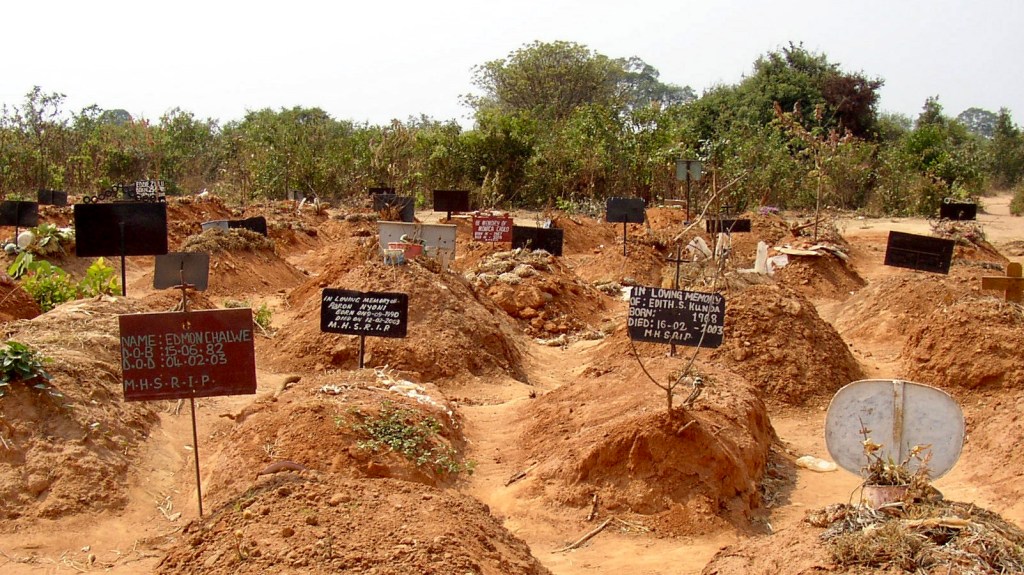
We left in a procession for the cemetery. The cemetery contains tens of thousands of graves, and over 200 were added each week for a period in the early 1990s. Each is a mound of dirt side by side with less than 18″ between. The cemetery continues to carve its way into the vast Zambian wilderness. We passed hundreds of fresh mounds. Many graves were unmarked or just had a handmade marker of some sort.
The coffin was lowered into the ground with ropes. They waited as the men took turns shoveling in the dirt, and then the mound was formed to mark the grave. Flowers were laid on the grave. While they were burying the deceased, two other funerals were going on right beside them. They had to be careful where they stepped because there were so many fresh graves that had been dug for other funerals that day.
The Universal Human Condition
In the 1995 a doctor at Kitwe Central Hospital told me that 80% of all cases treated were HIV/AIDS-related. The AIDS pandemic is such a terrible affliction! The greatest medical minds in the world admit that there is no cure, although, with the availability of anti-retroviral drugs in the late 1990s, quality of life has been extended for those with the disease who are on the medications. This terrible disease attacks the immune system and often results in the gradual loss of health, followed by death from any number of illnesses due to a compromised immune system.
While medical advancements have made great strides in combating diseases like HIV/AIDS, humanity still faces many challenges that cause immense suffering, ultimately resulting in death. Beyond physical ailments, there is a universal human condition that, left unaddressed, affects every person regardless of their background or circumstances. This condition is a spiritual sickness of sin resulting in eternal separation from God and has far-reaching consequences.
Just as medical researchers tirelessly work to find cures for physical diseases, there is a solution offered for this universal human condition of sin. The gospel of Jesus Christ and the gracious gift of salvation from sin offered to all who will believe and receive it present hope and restoration to those under its condemnation. The Gospel offers reconciliation with God and a transformation of the heart and mind. You can learn more about the good news of forgiveness and the hope of heaven here.
The Apostle Paul knew the gravity of the situation we face when he penned these words to the believers in Rome: “For whosoever shall call upon the name of the Lord shall be saved. How then shall they call on him in whom they have not believed? And how shall they believe in him of whom they have not heard? and how shall they hear without a preacher? And how shall they preach except they are sent? As it is written, How beautiful are the feet of them that preach the gospel of peace, and bring glad tidings of good things!” (Rom. 10:13-15)
Our mission is to share this message of gospel hope and renewal with those who have yet to hear it, believing that the gospel has the power to bring salvation to anyone who believes, resulting in a change in individuals and, through those redeemed individuals to communities around the world.
 Zambia Hunt
Leave a comment